Review: Runequest Without a Gamemaster
I want to start by saying that I’ve never played Runequest.
I don’t know why I have this supplement, honestly. I think I saw someone recommending it a while ago and picked up the pdf on a whim.
Anyway, I’m glad I did, because it’s awesome.
If you’re familiar with other GMEs, like Mythic or the Unfolding Machines, for instance, then Runequest Without a Gamemaster (RWG) won’t overwhelm you.
It has what you expect of such a supplement: a guide to play the game by yourself using oracles. However, I think Mark Prier, the author, went beyond both in style and content. There are some very cool solo mechanics that were new to me, tons of thematic spark tables and oracles specifically designed for Runequest, and the most incredible actual play example I’ve seen in a supplement, surpassing even the Mythic ones. That’s quite a tall feat!
It’s also worth mentioning that for every section and mechanic in the book, there’s a box showing how to adapt it for co-op sessions instead of solo. Nice little addition.
The Basic Mechanics
The play loop offered by RWG is to come up with a couple of Game Issues, create Goals derived from those Issues, then set up and play the scene.
Game Issues
Game Issues are ongoing forces in the character’s life. They can be problems, relationships, conflicts, events, themes, or facts about the character’s circumstances. The book recommends beginning with two: one representing something fundamental to the character’s life and another representing the immediate situation that kicks off the adventure.
Initially tied to your adventurer’s backstory, Game Issues evolve and change as you play, their relevance advancing and receding, helping to shape the game. Later Game Issues naturally arise in response to your adventurer’s actions, reflecting their place in Glorantha.
The second Issue will inform the starting goal and kickstart the gameplay. It must be something immediate and unavoidable.
If you have trouble coming up with Game Issues, the book offers plenty of help. The first is rolling on the spark tables for ideas and inspiration. Prier also recommends looking at the character’s passions, skills, backstory, family history, or past Runequest publications for their wealth of events, history, seeds, and inspiration.
These are actually great suggestions to interpret the game’s concepts through the character’s eyes and make the initial set up feel more personal, even if using random tables.
Goals
Goals are smaller and more specific, and also a big part of how characters deal with the Game Issues.
The first Goal should be related to the second Game Issue, the most immediate one.
Think of something the character wants to achieve. It doesn’t have to be perfect, just clear and enough to start the first scene.
Some examples:
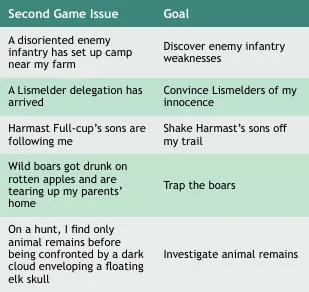
Game Issues are distinguished from Goals by their complexity. While a Goal represents a localized objective, a Game Issue represents a persistent force.
After creating the first one, we are free to create others if we wish. And of course, many other Goals will appear as we play through the game, resolve situations, and interact with the world.
Complexity and Headway
Goals and Game Issues are tracked through accumulated progress (Headway) dictated by Complexity.
Complexity determines how difficult or involved something is, while Headway represents how close the character is to resolving it. The less complex something is, the more Headway you gain, and vice-versa.
There are six Complexity levels ranging from Simple to Nearly Impossible, with corresponding Headway increases ranging from +40% down to +2%.
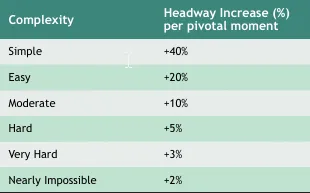
The higher the Complexity, the more time you spend dealing with that Game Issue or Goal. A Game Issue or Goal that is just a quick diversion should be set to Simple. One that is extremely difficult to deal with should be set to Very Hard or Nearly Impossible.
Completing tasks increases the Headway for a Goal, and completing Goals increases the Headway for Game Issues. It’s a great loop to advance the narrative.
At any point, we can make a Headway Check to conclude a Goal or Game Issue. I’ll talk about it a little later.
Scenes and Fortune
I won’t go into details of how a scene is played, as that is really up to player’s preference. Go with your gut, randomize everything with oracle questions and spark tables, summarize events or play minute by minute, etc.
However you like to play, the book got you covered.
What I do want to highlight is the Fortune system. For those familiar with Mythic, it works like the Chaos factor.
Fortune is a new mechanic for playing RuneQuest without a gamemaster. It is the wild will of Glorantha acting upon your adventurer and their story, combining good luck, fate, destiny, and divine favour. As your adventurer moves through Glorantha, your Fortune fluctuates, affecting scenes.
Fortune starts at 50%, and can range from 1 to 100. At the start of every scene, we make a d100 Fortune check.
Rolling equal or below the current Fortune is a success — the scene is unaffected. Rolling above is a failure — Fortune changes or replaces the scene altogether.
The value of the ones die tells us which result of the Fortune Table we got. For instance, rolling a 54 at 50% Fortune is a failure. The ones die is a 4, so we check that entry on the Fortune Table:
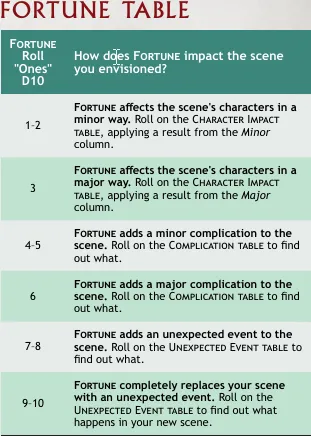
As you can see on the pic above, there are 3 more tables to roll on to see how Fortune affected the scene: Unexpected Events, Character Impact, and Complications.
Fortune can also be spent to alter rolls. Simply spend 1% for each unit you want to alter.
For instance, Fortune is at 50%. My Headway for a Goal is at 80%. I make a Headway Check and get a 96, a fumble. I want to change that result into a normal success, so I spend 16% Fortune, turning the 96 into an 80. Fortune now sits at 34%. Scenes will get more chaotic!
I loved the Fortune mechanic. Yes, it’s very similar to the Chaos factor, but I think it does its own thing with a certain charm. It’s more specific, and the multiple tables add a nice variation to the changes.
After a scene ends, we decide how Fortune fluctuates depending on how things went for our characters.
The Headway Check
Game Issues and Goals aren’t automatically completed when Headway gets to 100% (if it ever gets there). At any point, we can choose to make a Headway check to discover how they will conclude.
We roll a d100 against the current Headway and consult the Headway Check Results Table.
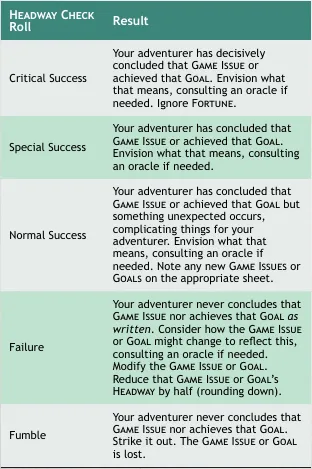
A normal success doesn’t conclude the Goal or Issue. There’s still a complication to deal with. It doesn’t have to be related, it can be something new generated with the help of the Fortune table or any of the oracles.
Failures force us to change the Goal or Issue. They’re impossible to conclude as they are, maybe because the character underestimated or misunderstood them.
With Headway check failures, it’s important to remember that the consequences don’t have to be dire: don’t cripple your adventurer or your adventure. Just imagine a setback that delays or changes how they go about achieving that Game Issue or Goal. For fumbles, remember to make the complete derailment fun for you as a player. Don’t punish yourself on account of the result. Find a way to move on that’s still fun.
Challenges
Some tasks aren’t big or complex enough to be labeled as a Goal, but neither they are so simple to be resolved with a single roll.
For those situations, we have Challenges, a special type of goal that allows multiple Headway increases during a scene.
There are some other mechanics suggested for Challenges, like Opposed Rolls and different ways to increase their Headway.
Each skill roll or attempted at progressing through the challenge increases progress. Even failed rolls advance it at half the normal rate.
We decide how the character is tackling the problem, make the appropriate roll, and then interpret what happens.
Progress can also happen through roleplay instead of checks. A conversation might reveal new and relevant information for a Challenge, for instance.
Challenges are also recommended for exploration and travel procedures, where we choose an Approach, summarizing how the character deals with the situation, and make a roll on it.
Oracles
The first oracle suggested in the book is the Gut Check Oracle. If you have an idea of what happens or how to move the story, use it. You are the best oracle to consult, so develop your creative instincts.
After that, The Primary Oracles have all the usual tools of GMEs, like Yes/No, Likelihood, Qualifier, and Degree oracles. Basic stuff.
I like how the book suggests not using oracles and leaning into skill, runes, passions, and characteristic rolls instead.
This is something I’ve first learned with Befallen. There are no oracles in that game. If you want to know, decide, or discover something, you make a skill check (Instead of “Does the guard see me?, you roll Sneak). The result will provide information and drive the narrative.
The same is suggested in RWG. It’s a great recommendation for any game, really, using the baked in mechanics first instead of relying on outside tools.
Next, we are introduced to the Actions, Objects, and Qualities Oracles for generating prompts and interpreting unexpected results. Each of them has four columns with 100 entries, for a grand total of 400 items on each table!
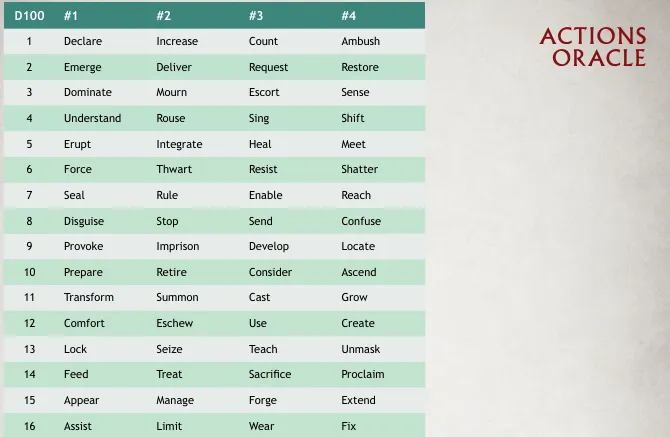
The Additional Oracles go further. There are tools for animals, character occupations, attitudes, motivations, skills, passions, personality traits, Runes, character statistics, cults, languages, locations, settlements, buildings, rooms, caves, terrain, treasure, sounds, smells, and a lot more.
Again, the book goes above and beyond with tables and generators. It’s a really complete and versatile GME, with a wealth of random content to fit into any game.
Combat
From what I read, combat in Runequest has a lot of granularity. To simplify it, RWG offers six options to deal with it.
1. Battle Skill
This one simplifies resolution for mass skirmishes or any kind of combat, really. Just make a Battle skill check to know how your character fared in battle and consult the Battle Result Table in the main book (Runequest: Roleplaying in Glorantha).
2. Panic and Hostility
A behavioral and tactical engine that removes player bias using “Panic Increase” and “Hostility” tables.
Damage, unconsciousness, incapacitation, and death can increase panic, while hostility and combat intent tables determine how adversaries behave.
The higher the Hostility, the more damage characters must inflict before enemies panic. When Panicked, enemies focus on defense and retreat.
There are several tables with different combat stage reactions, body part targeting, panic increase, and so on. It’s a very cool and unique mechanic.
3. Combat Snapshot
Combat is streamlined by using “Combat Points” to calculate attack results and damage.
Hits, crits, misses, and damage have different points. If combat hasn’t ended after one or two rounds, tally up the points for both sides. The group with the highest number wins.
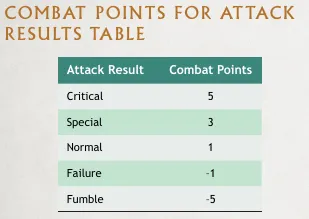
The difference in points between the groups also affects the result according to the Combat Snapshot Outcome Table.
Another great choice for solo players.
4, 5, 6. Compressed Combat
Options 4-6 are increasingly flexible ways to abstract combat.
Option 4 resembles Option 1 a little, where we make a single roll to narrate an entire encounter. However, we can choose any skill capable of inflicting damage that fight.
The result of our roll (crit, special, normal, failure, or fumble) is checked on two Compressed Combat Tables, one for our characters that tells how we fought and one for the enemy to determine damage and the combat’s outcome.
We don’t need to roll for enemies. Our single skill check will inform both results.
Option 5 adds a risk/reward mechanic called Betting. We can invest character’s resources like HP to augment the skill check.
Option 6 is to use the Challenge mechanic I explained before, using a few different mechanics for it.
Actual Play Example
After all instructions are laid out, the book gives us 100 pages of actual play, showing all mechanics in action. This alone should sell this book. I’ve never seen something like this, as it’s quite different from the examples in Mythic.
It’s an actual playthrough of the game scene by scene, telling a continuous story, showing examples, and diving into the book’s concepts.
The examples will help even experienced players, but especially those who’ve never played solo before. They show how to move from a dry oracle result to a fully realized scene, teaching the player how to use randomized rolls to push the narrative.
Scenario Starter: The Caves at Two Faces
Prier included a starting scenario to ease players into the system and solo mechanics, The Caves at the Faces.
It’s a structured scenario that works like a CYOA book, but with plenty of room to inject our own interpretation. Even the pre-made scenes, called Triggered Scenes, are considered a starting point.
It reminds of Alone in Deepfall Breach, the solo module for Dragonbane.
There’s guidance for every step of the scenario, from character creation and starting motivation to confrontations and concluding the story.
Conclusion
Runequest Without A Gamemaster is a fantastic toolkit that leans into the original game’s complexity (from an outside perspective, at least) to give players a complete and satisfying solo experience, with plenty of crunch and narrative aids.
Even better, it doesn’t have to be exclusive to Runequest. The mechanics gel well with any other game.
There are many interesting and clever concepts to bring and adapt to your arsenal of solo resources.
Get it even if you’ve never heard of Runequest and join the club. There is at least one other member!
Runequest Without A Gamemaster is available on DriveThruRPG.