Shinsei: a Nioh-inspired solo action TTRPG
Something a little different today: my very amateurish and loose attempt at designing a solo TTRPG.
This is by no means a serious commitment, hard goal, or anything like that, so please bear with me. It’s just a creative exercise going a little off-rails.
Shinsei is my interpretation of what a Nioh-inspired, action looter solo rpg would look like. I had a lot of fun coming up with a few systems for it, and while it’s far, FAR from a playable state, I had to dump the thoughts and efforts that went into it so I can relax and put them to rest.
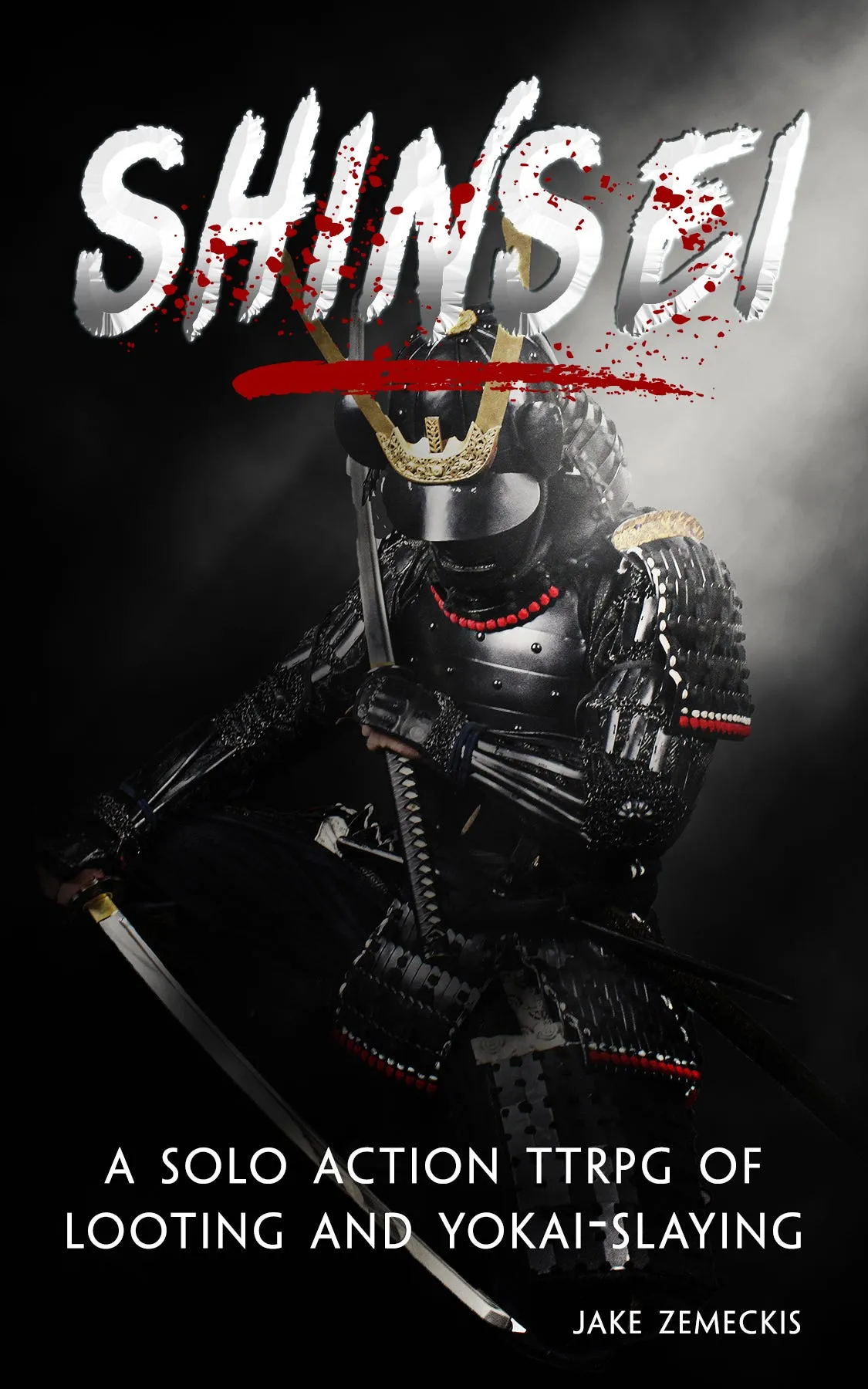
This is the cover for it. I love creating covers. It’s a very fun part of the creative process for me, even though I suck at it. I’m just blind for graphic design.
Concept and systems
This is Shinsei’s tentative premise:
When you stare too long into the Abyss, you conquer it.
Previously a forgettable warrior of mediocre skill, you have died. Now, cursed blacksmith Muramasa reforged your spirit into a yokai-slaying Revenant, bound to the Endless Abyss to do his bidding: vanquish the Akuma and Kami in the Depths and discover the ultimate gear combination.
The game uses a d20 roll-under system. There are no roleplaying elements yet, just pure combat and looting.
Combat uses an opposed d20 roll. Whoever rolls the highest under the skill value wins the confrontation and hits a successful attack.
Damage is dealt automatically, equal to half the d20 value rolled rounded up. For yokai, the number rolled also determines the action they use.
Finally aware of your past mediocrity, you now cultivate a beginner’s mind. You understand the worthy pursuit of unattainable mastery, and the value of endless repetition. There’s much to be learned not only in failure, but also in moments of apparent flawlessness. Perfection, when dissected, is humbled.
20 is a Fumble. You lose the confrontation and take max damage. 1 is a Critical Hit. You win the confrontation and deal max damage.
There are six weapon types in the game: Katana, Dual Swords, Tonfas, Kusarigama, Odachi, and Spear.

Weapon skills are called Weapon Arts (WA). Rolling Fumbles or Criticals for Weapon Arts grants a Mastery Mark for that Art. For now, Mastery Marks can be spent to:
- Attempt a Weapon Art Improvement.
- Gain a new Mastery or Ability.
- Ensure loot drops.
- Add another die when rolling for Properties.
- Reforge gear Properties with Muramasa.
Mastery Marks can only be used at Shrines during Meditation.
To attempt a Weapon Art Improvement, roll a d20. If the value rolled is higher than the Weapon Art score, it increases by 1. If it’s lower, the Mastery Mark is lost. Some failures are pointless, and you are wise to recognize that.
Improvements cost:
- 1 MM if the Weapon Art is under level 12.
- If the Weapon Art is 12 and higher, it costs the current number of the ones value. 2 for level 12, 3 for level 13, and so on.
For each weapon type, you can learn Disciplines (passive skills with permanent bonuses) and Techniques (active skills to be used in combat). Standard Techniques require an opposed combat check and only work on a successful hit. Free Techniques activate instantly and don’t consume your action.
A few examples:

Starting WA of your chosen weapon is 12. Choose a second for 10. All others start at 8.
There are also Resistances. They’re rolled under as well, but are not skills. They don’t fumble or crit, and can only be increased by gear. Their maximum value is 16.
Endurance: physical-related.
Serenity: mind-related.
Essence: magic-related.
Combat
Again, opposed d20 rolls. The winner deals physical damage equal to half the roll (rounded up), unless stated otherwise.
Minimum damage dealt is always 1.
Elemental damage ignores Defense.
Players have 5 Ki. Used for Techniques and actions. Actions are: Techniques, Focus, Attack, Block, or Parry.
Focus recovers all Ki. You must then Block with -4 WA for that round.
Attacks are simple opposed rolls. Blocks negate damage from all attackers and let you Counter. Parries negate damage and cause max damage to the opponent.
Missing a Block has no penalty. Missing a Parry makes the enemy deal max damage to you.
Attacks and Parries can lead to Combos. Spend 1 Ki to chain another attack, unopposed. Missing, however, causes the enemy to Counter.
Counter: roll Attack with Advantage.
Advantage: 2d20, keep preferred value.
Disadvantage: 2d20, keep value that would hinder you the most.
If both miss, 1 damage to each.
Combos = 1 Ki each. Each hit suffers a cumulative -1 WA.
Block = -2 WA per enemy. Crit auto blocks all enemies. Fumbles cause max damage from all hits.
Parries = -1 WA.
Max damage = The maximum damage a creature is capable of dealing, including modifiers. If your weapon art is 16, and your weapon has the property +2 damage, your max damage is 10. If a yokai has a combat skill of 9, its max damage is 5.
All Ki is recovered after combat.
Initiative
A samurai strikes fast and strikes first. You are but a filthy Revenant, and even so that precept is instilled into you.
Actions in combat usually happen simultaneously. When facing multiple yokai, the player always acts first. The remaining yokai act unopposed.
Short example
Take this enemy:

Yes, the scaling is a bit of a mess, but let’s power through it. We’re on Depth 1, so its HP is 12. Our starting WA is 12. Its Combat Skill is equal to our highest WA (of equipped weapon) -4, plus Depth divided by 3 (rounded down). That’s 12-4 = 8. Its Defense is 1.
The Depth scaling for this yokai will only come in play in Depths multiples of 3.
Let’s roll a normal attack.
Revenant d20 (12): 10
Skeleton Warrior d20 (8): 11
I win the confrontation and deal 5 damage, reduced to 4 by the yokai’s Defense. HP 8/12. I’m using 1 Ki to Combo (-1 WA)
Revenant d20 (12-1): 8
Another hit, dealing 3 damage (5/12). Another combo (-1 Ki, -2 WA).
Revenant d20 (12-2): 18
I miss the combo, making the enemy Counter. Its next attack gains Advantage. Let’s go for a Parry (-1 WA):
Revenant d20 (12-1): 11
Skeleton Warrior d20 (8): 14, 18
Awesome roll, just on the edge. I deal max damage (6) and finish the Skeleton Warrior. Now I loot the yokai, rolling on its Loot Table.
I’m still figuring out names for the items and their uses (all outside of combat).
Gear Properties
This is a looter game, so there’s plenty of loot.
Gear can be Common, Rare, or Divine. Each type can contain a Minor or Ascended Harmony (parts of a Set that provide bonuses the more pieces we have equipped).

This is the tentative table for Common Weapon Properties:

The Abyss Depths
Every Abyss Depth starts with a Usage Die 10 (UD10). Roll the UD at the start of every area. If the die doesn’t change, roll for a normal encounter.
Whenever the UD goes down, you’ve found an Akuma. They’re randomly generated elite enemies.
When the UD4 activates, you’ve found the Depth’s Kami. They’re the randomly generated boss for that Depth.
You don’t have to fight the Kami or the Akuma as soon as you find them. You can keep exploring the Depth, mapping all Akumas and the Kami until you’re ready to face them.
After an encounter is rolled for the area, that roll is permanent. Those enemies will always appear in the current area. After being killed, they respawn after Meditation.
After an Akuma is vanquished, it doesn’t respawn. The area is purified and gains a Shrine (a Dark Souls bonfire to Meditate, summon Muramasa, and serve as checkpoint).
After a Kami is vanquished, that Depth is purified and you may move on to the next one. Kamis and Akumas don’t respawn. All enemy Loot Table results of 1 and 20 are void, not dropping anything anymore.
I’m considering a permanent general layout for each Depth, rolled when we enter. Something like Linear (exploration is done in sequential areas, always north), Lotus (1 area north, 1 area east, 1 south, 1 west, connect and repeat), etc.
Other stuff
I’ve written Muramasa Events to happen at certain thresholds and specific conditions, just like Achievements. The cursed blacksmith begrudgingly respects our effort and gifts us powerful gear.
As you can see, this is very crude, and it’s all a mess. There’s a lot to balance, include, and remove, and I’m having a lot of fun navigating though all that.
I’ll still continue to tinker with Shinsei during my free time, because I’m loving this kind of creative exercise. Even though I’m honestly trying to make something cool, the final result isn’t the point for me. Working on it and having the odd epiphany of how something clicks together is incredible feeling. It’s such a cliche, but it’s about the process.
Anyway, I just wanted to share this little practice with you all.
Thanks for reading, and until next time.