Let’s Play Grok?! 2e Part 1: Overview and Character Creation
Hey, everyone! I’ve been wanting to start a Grok?! 2e playthrough ever since the Kickstarter fulfilled, but I keep shelving it.
I’m not into scifi at all, and even a tiny bit of it puts me off. I have a hard time being creative around it because I don’t enjoy its settings and concepts.
Consuming scifi stuff is usually the same. I generally avoid it, with a few exceptions. Hitchhiker’s and Red Dwarf are some of my favorite books ever.
Anyway, every time I read Grok?! 2e, I have a blast with all its content. The gonzo world, the absurd tables, the GORGEOUS art, the author’s voice, the fun and lightweight systems, etc.
It’s time I gave it a proper try.

Overview
Created by Lester Burton (Gander Gaming), Grok?! 2e is a TTRPG set in a gonzo science-fantasy world.
Grok was once a bastion of advanced technomancy until a catastrophic event shattered the planet.
Now, arcane magic and ancient high-tech relics coexist in strange environments, like Hovering Isles, the dystopian Simulacrum, and the desolate surface of the planet, the radiation-laden Wastelands where friendly Vagabonds roam.
The setting is deliberately anti-canon, meaning there is no "official" lore. Everyone is free to shape their own version of this strange place.
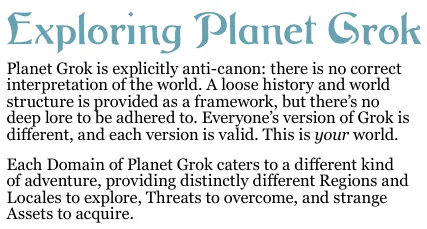
As inspirational touchstones, the book lists, among other things, Discworld and The Hitchhiker’s Guide to the Galaxy. I had to back it as soon as I read the description.
What also sold it to me was the art. It’s easy to say this in hindsight, but Lester apparently found the perfect artists to work on the book, and they completely understood the assignment.
The tone, writing, and art in Grok?! 2e perfectly complement and build on one another.

Grok relies on an intuitive player-facing system that favors narrative and description. The game was also designed with solo support, which is always a huge plus!
Attributes and Checks
Characters are defined by three core Attributes: Physical, Mental, and Social.
Each Attribute is assigned a die ranging from d4 to d12 (d10 max for starting PCs). Checks are made by rolling the relevant Attribute die against the Outcomes Table.
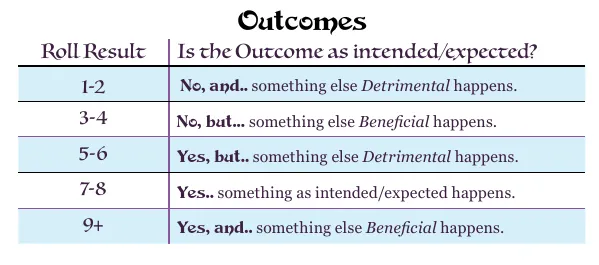
Reading the table, you might ask, "How the hell can I succeed with a d4 Attribute?" Well, the dice can explode!
Whenever a die lands on its maximum value, we reroll it and add the result. Dice can explode indefinitely.
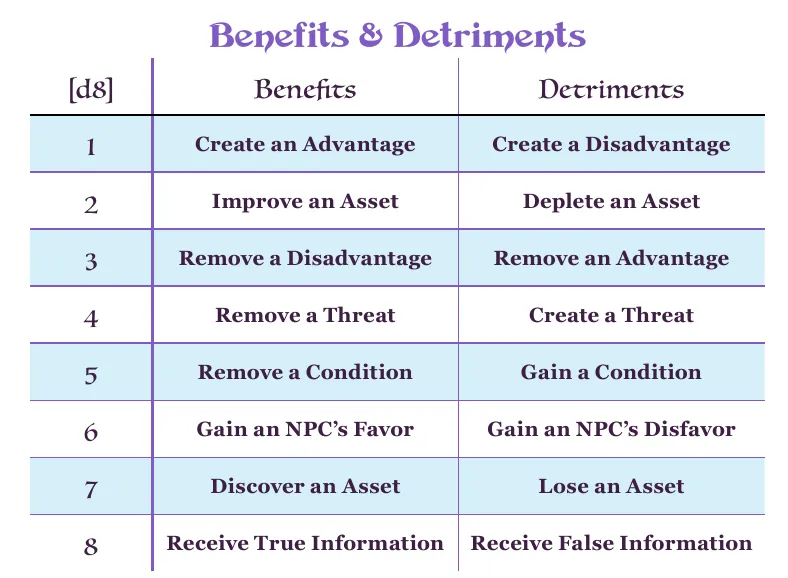
There’s also the option to Push a Roll. To Push, we reroll the Attribute die and add it to the previous result, but doing so always incurs a new Detriment for our character. We can invent a narrative Detriment or roll on this handy table:
Aspects and Traits
There are no skill lists, HP, or a classic inventory system in Grok. These things are represented via Aspects and Traits. They’re single words or short phrases that describe who the character is, what they can do, their motivations, etc.
Anything in the game world can be translated into an Aspect. Currency, gear, items, spells, companions, npcs, vehicles, and more, are all tracked as Assets, a type of Aspect.
Characters carry a limited number of Asset Slots. Taking damage or stress fills an empty slot with a temporary Condition. If all slots are full and another condition is taken, they suffer a Debilitation, shrinking one of their Attribute dice.
This loop of Conditions and Debilitations is how HP, damage, and recovery are abstracted.
Traits are considered a type of Aspect. They represent who the character is: personality, background, appearance, motivation, flaws, and so on.
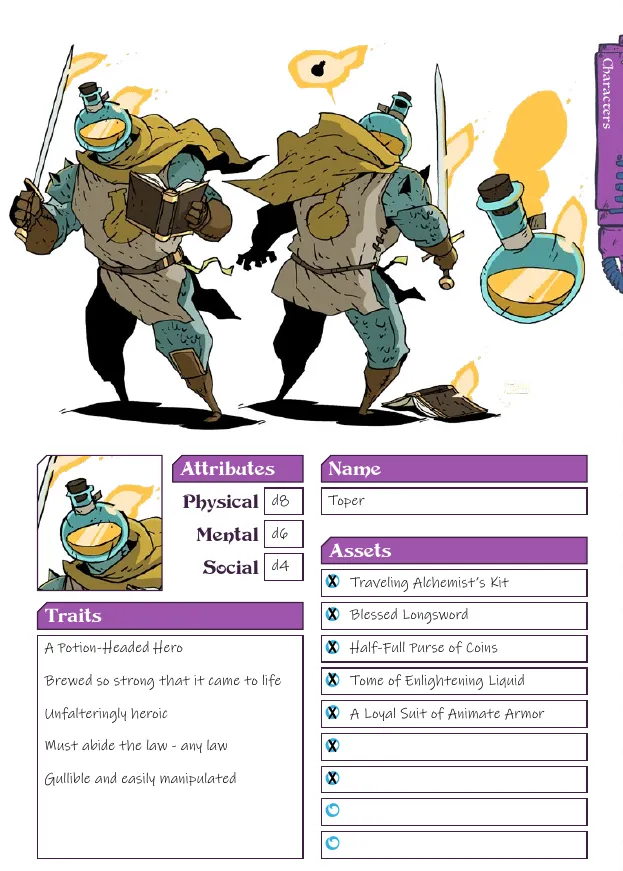
To make it easier, check one of the many pre-made characters included in the book:
It’s a very fun narrative system. If I’m not mistaken, FATE also uses a system with Aspects, and Legend in the Mist has a similar mechanic in the form of Tags.
A lot of other games use it too, but those two come to mind.
The Solo System
Besides an oracle and several random tables, Grok?! 2e features a dedicated solo system with a very cool approach called The Adventure Loop.
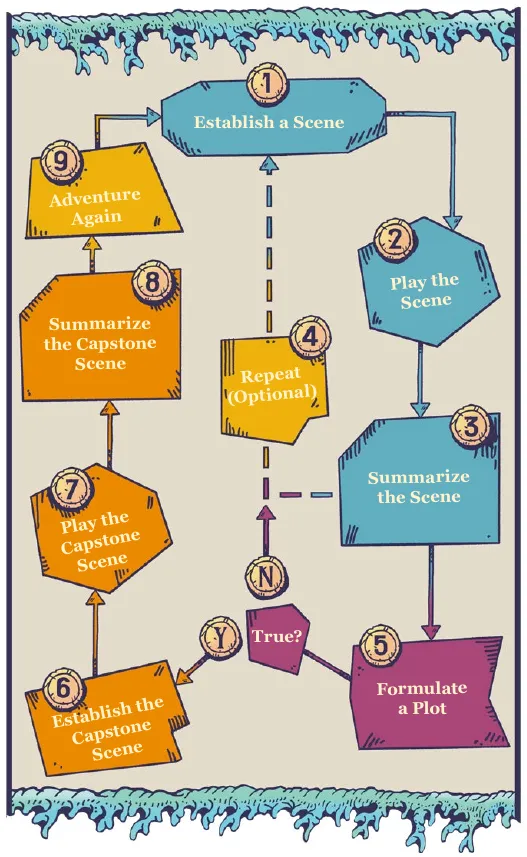
Most of the steps are self-explanatory. We generate scenes, play them, record brief summaries, and move on.
But steps 5 and 6 are unique to this loop. They take us to the climax of an adventure.
After playing a few scenes, we propose a theory to build a narrative arc that attempts to explain what happened so far. Then we test the theory by making a sort of narrative check, rolling a d10 on the Outcomes Table. We gain advantage or disadvantage (extra d10s to pick highest or lowest result) for each scene that supports or contradicts our theory.
The plot can turn out to be true or false. If true, we create a Capstone Scene, a high-stakes event to bring the adventure to its climax. If false, we either play more scenes to formulate a new plot or we Push the roll!
Like normal checks, pushing the roll here comes with a Detriment. It is applied to a previous scene summary or to the plot itself, revealing unknown components and making the Capstone Scene more complicated.
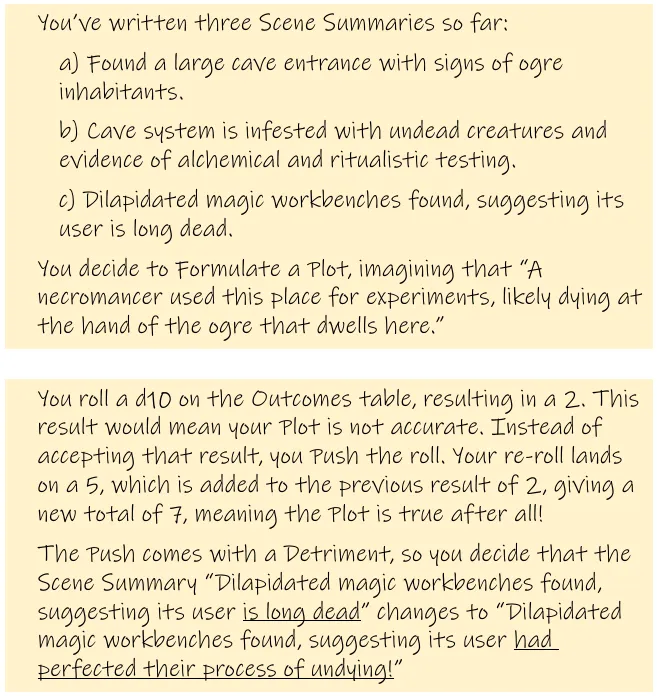
Here’s a great example from the book:
I think this is enough of an overview to get started. I’ll go over new concepts and mechanics as I play.
Also, I won’t go over everything here, but the book has a ton of lore for each region of the planet, tips on worldbuilding, a bunch of optional rules, and even a starting adventure.
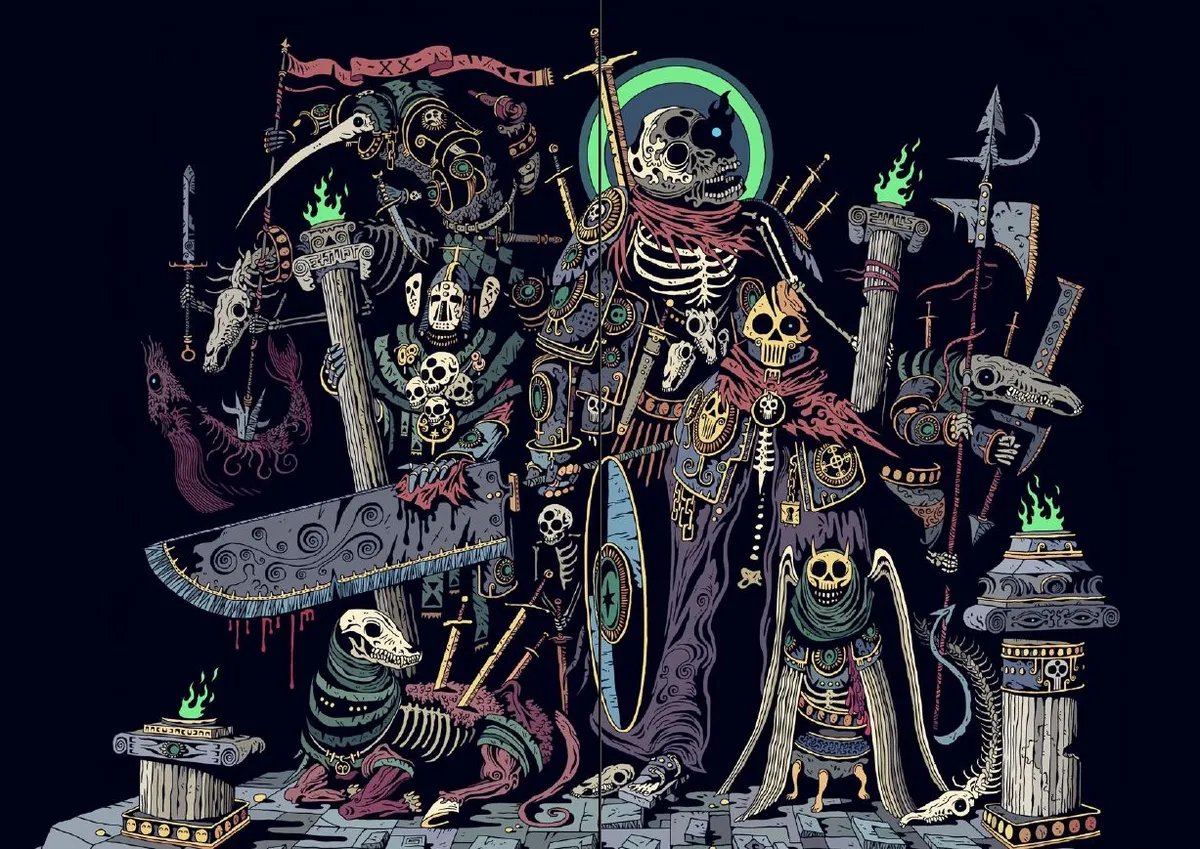
I can’t recommend the game enough. It’s worth it for the art alone.
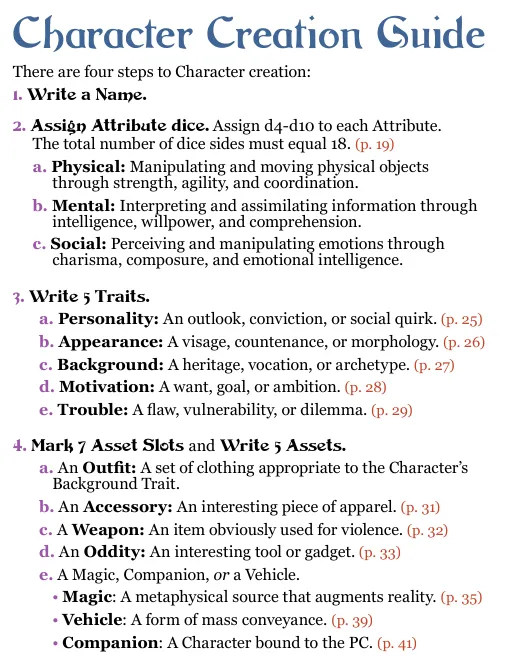
Character Creation
Alright, let’s go through the quick process of character creation!
I like creating characters according to the story I wanna play. In the world building section, I read a little example region that really stuck with me: the Isle of Living Books.
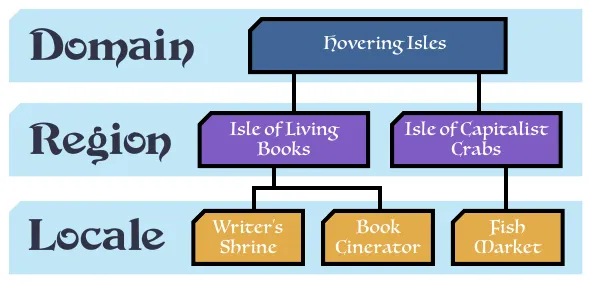
That brought to mind the Discworld librarian and all the chaos involving books and the library in the series.
I wanna play something similar. Not in the Hovering Isles, but on the surface. Let’s say my character is a librarian.
When assigning dice to the Attributes, the total sum of die sides has to be 18. I’m going with:
Physical: d4
Mental: d8
Social: d6
Using my Absolutely Awesome Fantasy Names tables, I got:
First name: Catarina
Last name: Grief/Tear + Blue/Green
Catarina Bluetear sounds awesome!
For her traits, I’ll roll on the random tables in Grok:
Personality: Ruthless
Appearance: Giant
Background: Cult acolyte
Motivation: Enlighten self
Trouble: Deranged
LOL, my god. What a combo!
I’ll make Catarina really tall and lanky, not an actual giant. She used to be an acolyte for a cult worshipping the Great Ones, god-like behemoths from other dimensions. Her true love, however, was bureaucracy.
She is ruthless when it comes to rules, fillable forms, regulations, and laws. If there’s a proper protocol to do something, she will enforce it whatever the cost.
Reading books on regulations and dense manuals was her favorite pastime between serving eldritch inter-dimensional beings. However, her passion for paperwork became an obsession.
Catarina was fired from the cult, because even cosmic horrors have their limits, got a nice severance package, and eventually found a job in the place where she could ascend into a higher being of perfect protocol and dogma: a living library!
Now she tends to magical books and devours as many manuals, textbooks, enchiridions, and periodicals as she can. Her mind is slowly eroding under the burdensome weight of bureaucracy, rulings, and fine print.
If even filing systems are disrupted, she’s prone to manic episodes.
Ok, time for Assets!
Catarina wears librarian robes, ink-stained and with endless pockets. Stray index cards are glued on random parts of the fabric. She also has sturdy boots and reading gloves.
For the rest, I’ll roll randomly, except for the weapon. I want her to have some weird magic instead.
Accessory: Head lamp
Oddity: Memory magnet
Magic: [The] Rite [of] Seeing Organ
Holy hell, leaving things to chance in this game leads to crazy results hahah.
We’re supposed to choose either Magic, Vehicle, or Companion. However, I’m going with Magic and Vehicle since I forfeited the weapon.
In the end, it’s the same thing mechanically. They’re all Assets.
I won’t roll for the vehicle. I imagined Catarina flying around in a golden cloud like Goku’s, and I really liked that, so she has a Flying Nimbus.
The vehicles table is as gonzo as all others:
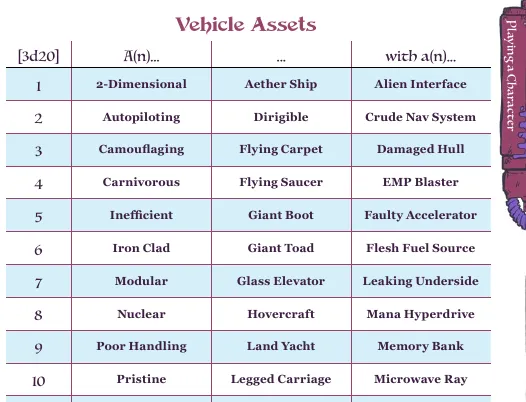
I was tempted by the Legged Carriage. Twoflower’s (then Rincewind’s) Luggage, anyone?
Anyway, putting the Assets together: Catarina’s headlamp can light dark vaults in the library and illuminate tiny footnotes that would otherwise escape her ruthless scanning.
The memory magnet is a weird device that can absorb and store thoughts, memories, or unwritten ideas, maybe even from other people’s heads?
The Rite of Seeing Organ is something she learned during her cult days. It’s an arcane conjuration that sprouts an ethereal eyeball that perceives magical auras, hidden texts, and other supernatural things.
When she uses it as a weapon, the eyeball fires an eldritch beam that forces a target to come to terms with all rules they’ve ever broken and every terms & conditions agreement they’ve accepted without reading. It can cause paralysis or some kind of existential dread.
Alright, that’s really fun. Catarina is obviously not one for melee combat or physical violence like in most of my games, but Grok isn’t like most games, is it?
Here’s her sheet:
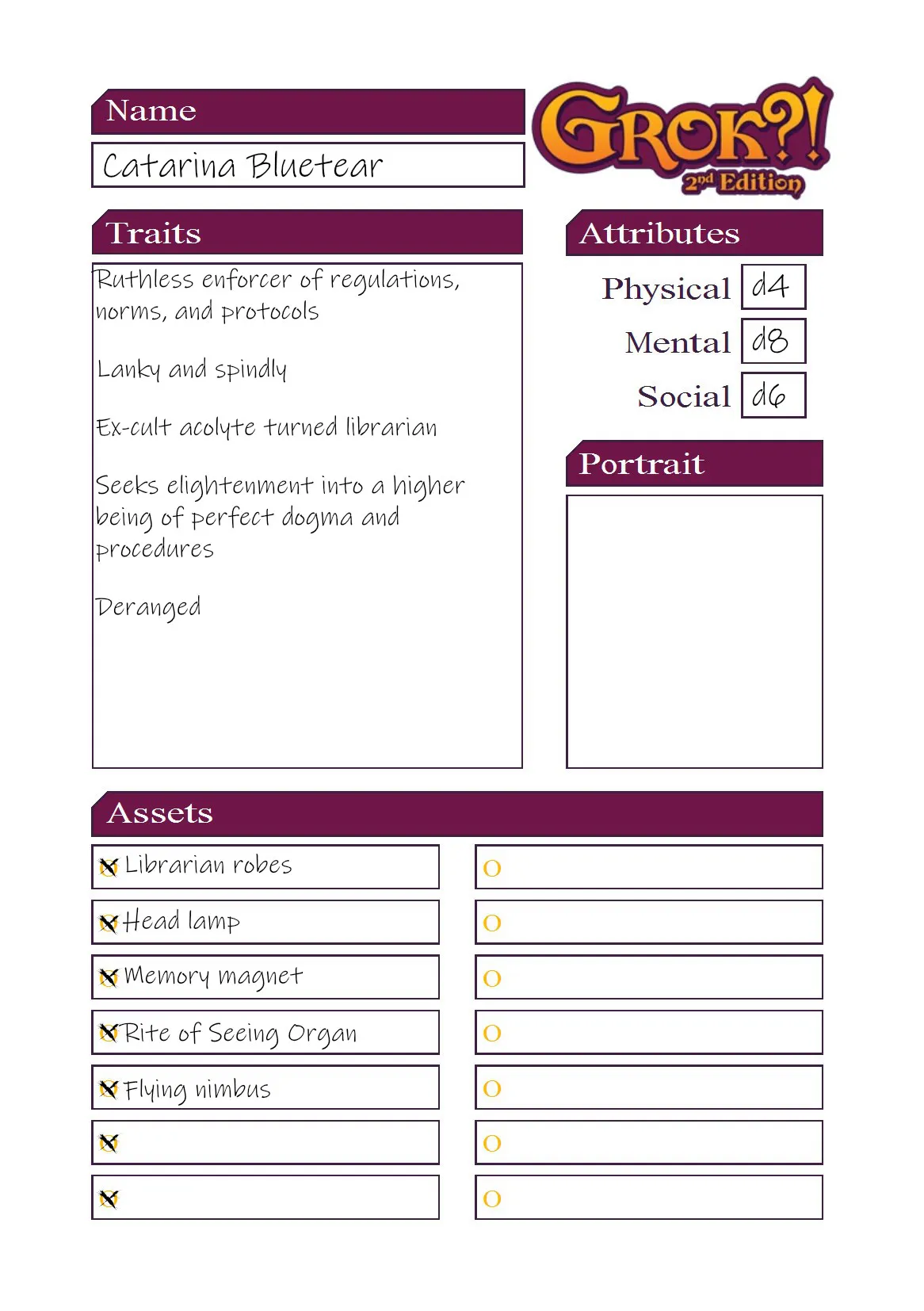
I’m excited to start! This is already looong, so I’ll do the setup and the first scene in the next one. See you then!
Grok?! 2e is available on DrivethruRPG (digital only for now). Feel free to check out the free Quickstart!
Join the Gander Gaming Discord as well. Lester and the community are very welcoming.