Let's Play Ronin (Mork Borg)! Part 1: Character creation
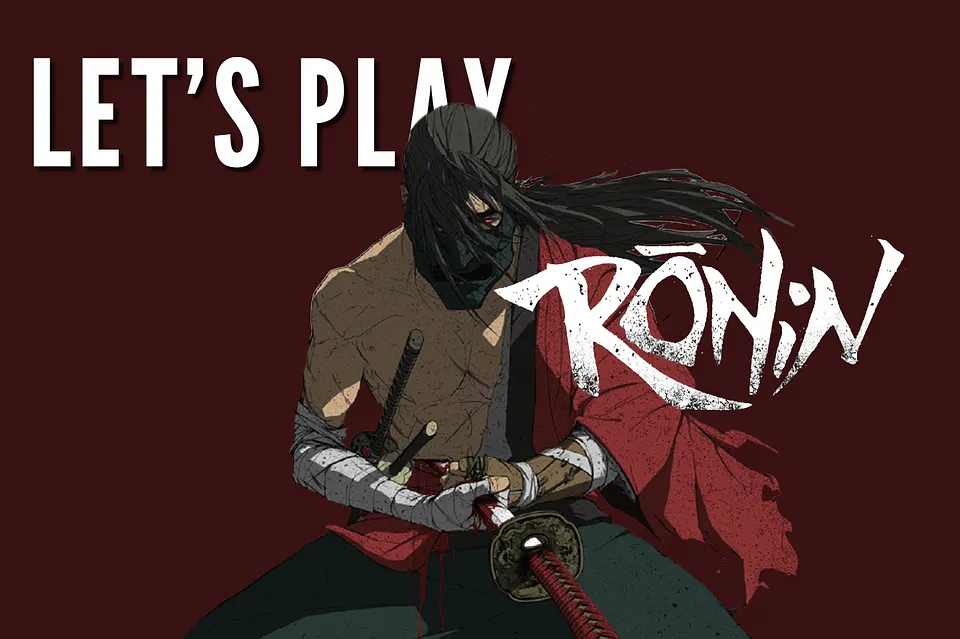
I’m in the mood for some dark fantasy samurai fun, so Ronin, a Mörk Borg hack created and published by Slightly Reckless Games, is my pick this time.
Ronin’s setting is Kage no Shima, the Land of Endless Night, an island inspired by Edo-period Japan, except it’s gone to shit after a supernatural eclipse and is now overrun by yokai (demonic creatures from Japanese mythology) and people of dubious character.

We have descriptions with flavor and hooks for the areas on the map, all in the Mörk Borg style of beautiful illustrations with layouts that go from deranged to captivating.
The world is bleak as they come. Even though honor is one of the main themes, most people are fighting for survival. Some warriors still cling to the old tenets of bushido like a disease that never heals, stuck in a time and place before the sun vanished and left only darkness and filth.
Maybe it’s because once you have lost everything, honor is all you can control in a miserable existence.

The game also leans into themes of rituals, death, and spiritual/mythical concepts. There’s even a mechanic for committing seppuku (ritual suicide) in order to regain honor. And dying in the land of eternal eclipse is not the end. The first time a character falls, they are cast in the underworld, and can claw their way to resurrection, proving themselves against a yomi demon.
If you’re familiar with the Nioh games, Ronin is pretty similar in tone.
Checks are rolled with a d20 plus (or minus) a stat modifier against a Difficulty Rating (DR). Dice rolls are all player-facing except for defense rolls from armor during combat.
In the official solo supplement, Tales of the Masterless, which I’ll be using, checks become moves, using 2d20 instead. If both dice roll equal to or above the DR, it’s a strong hit, a successful check. If only one does, it’s a weak hit, a success with a consequence. When both roll under, it’s a fail.
Even with a solo supplement, Ronin is definitely not balanced for solo. Since I don’t feel like creating and managing an entire party, I’ll be changing a ton of things to try to make the game more playable for a single character. Don’t worry, I’ll go over all those changes and point out what I’m doing.
I’ll explain other rules, mechanics, and concepts as I get to them. Let’s begin!
Character creation
If you’re going for a full random character, Slightly Reckless Games made an awesome online generator available here. I’m going step by step though, since I’ll change things.
The very first table in the book is for Names, so let’s start with that. I got Zen Battosai, which is pretty cool, especially if you’ve ever watched or read Samurai X (Rurouni Kenshin). For nickname I rolled a 4, getting Kawa no Kami, River God. Nice!
We can pick one of the 10 starting classes that come with specific gear and stat bonuses or randomize everything. I’m not doing either. Like I said, I’ll give myself an advantage for playing solo.
Equipment
We start with a waterskin (d4 uses), food (d4 uses), and 2d6x10 Ryo (currency). I’ll go with max water and food, and roll for money:
2d6: 8
80 Ryo, not too shabby!
I’ll pick a sack that can hold 10 small items. Then I’ll roll for the starting item and choose a weapon and an armor.
d12 starting item: 2, torches. Spirit+4 for quantity, I’ll just go with 5.
Weapon: Katana (d10 damage)
Armor: Tier 2, Medium. Defense is DR+2, -d4 damage. +2 DR on Swiftness checks. Style: do-maru, leather plates laced together with cords.
Attributes
We have 4 stats:

For custom characters, we’re supposed to roll 4d6 and remove the lowest value to determine the starting score, that ranges from -3 to +3. The starting HP is d8+Resilience.
This stems from OSR, and I really detest rolling for stats. I decided to distribute a +3, a +2, a +1, and a 0 among them, and go with max HP. Here are Zen’s attributes:
Swiftness +1
Spirit 0
Vigor +3
Resilience +2
HP: 10
Honor
Now we roll 3d6 for our starting Honor (this time we use the sum of the roll, not a bonus). I see Honor as a stat. It can be gained through a character’s actions, affects how NPCs react to us, and can concede bonuses or penalties. A character is dishonorable if their Honor is below 10, or honorable if it’s above.
I think it could be fun to use it like a sanity mechanic, with the character sinking and despairing the further they become dishonorable.
I’ll go for a starting Honor of 10. I’ll use this table for rolls where I think Honor could be a modifier:
 This is the attribute initial score table, from rolling 3d6 (or 4d6 for custom characters).
Honor tenets
Each class has a list of tenets to follow. The characters’ actions toward their code dictate whether they gain or lose honor. Here are the Erudite Samurai’s Bushido tenets:

I’m going with a mix of the class tenets, and I’ll create a new one (Acceptance).
Zen Battosai’s code of honor
Honesty: Be truthful in words and deeds. Avoid deception or trickery.
Mastery: Strive to improve your skills and abilities, to become a true master of your craft.
Dignity: Face death with dignity and honor, and never fear the unknown.
Honor: Maintain a strong sense of personal honor and integrity.
Precision: Every movement, every strike, every parry should be measured and precise.
Acceptance: Relinquish to transcend. In triumph or in defeat, glory or decay, a true master embraces their fate.
Feature
Features are unique class abilities that provide some kind of bonus with limited use. Take the Features from the Erudite Samurai as an example:

We can pick one from each class, and there are actually no rules for custom characters. Instead of picking an existing Feature, I’ll create one for Zen.
Iai Slash: A lifetime of discipline unleashed in a single draw with perfect form, from sheath to foe. Once per battle, cause full damage with an attack.
Virtues

Virtues are basically a resource used to influence dice and results, replenished at rest. Custom chars start with d2 Virtues, and classes can have up to d4. It’s not a permanent roll, though—at every rest, you roll the dice again and replenish that much until the next time.
Changing things again, I’m going to go with 3 Virtues for Zen, all replenished at rest.
Nothing like using Cheat Engine in a solo game, right?
Optional tables
There are some random optional tables that give flavor and roleplaying opportunities for our characters, so I’ll use a couple.
d20 broken bodies table: 3 = Missing a limb, using a makeshift prosthesis
d20 Grimchronicles: 5 = Once betrayed an old friend and has been wracked with guilt ever since
That’s a cool hook for Zen!
The other two tables are Bad Habits and Awful Afflictions, and I think they can deviate a lot from what I’ve built so far, especially from the Honor tenets. Those can be fun if playing more casually or with a group, but for now I want something more consistent.
Putting it all together
I’m imagining Zen as an older samurai, around 55, carrying in equal measure the mastery of discipline and the guilt of betrayal.
He had a pupil once, the daughter of a disgraced clan, during the age of samurai. Zen trained her in secret, seeing potential and hunger for perfection in her.
When the Shogun’s men discovered this, they demanded Zen turn her in. True to his code of honesty, dignity, and honor, he did, thinking he could reason and protect her.
They killed her before him, and as punishment, took his arm as a reminder to never defy the Shogun again. Only his reputation and standing saved his life.
Her accusing eyes would haunt him forever.
Zen would later acquire a makeshift prosthetic and practice his skills until completely spent, then meditate. Discipline kept him going through the years as he refined his swordsmanship to perfection. Even without a limb, his movements remained fluid. His blade flowed like running water. This earned him the nickname Kawa no Kami—River God. When Zen drew his sword, nature held its breath.
Meditation improved his mind, and he learned to accept his past mistakes, but it wasn’t always easy.
Zen Battosai wanders Kage no Shima and offers protection to villages cursed by yokai or honorless scum, accepting whatever reward he’s offered. Drawing his katana for something is enough. Maybe redemption can be found through mastery and precision.
He outlived the age of honor, but its ghosts still haunt him in the age of darkness.

And that’s it! Now we’ll see if this makes Zen strong enough to venture alone in Kage no Shima, but not to the point of being a superhero.
Ronin and Tales of the Masterless are available on the SRG website and DriveThruRPG.
The barebones edition is free! It’s an art-lite version of the full rulebook.