Let's Play The Outcast! Part 1: Overview and Setup
Let’s try another creation by Cezar Capacle! This time I’m diving into The Outcast: A Game of Reputation and Redemption.
Like Capacle’s other works, this is a rules-light solo rpg about isolation, survival, mistakes, and redemption. We embody an ostracized traveler embarking on a lonely journey to rebuild their tarnished name.
The Outcast is a solo RPG about reputation and redemption. Your character has been ostracized by a community they were once part of because of a mistake they say you made. You embark on a lonely journey fulfilling missions to try and restore your reputation.
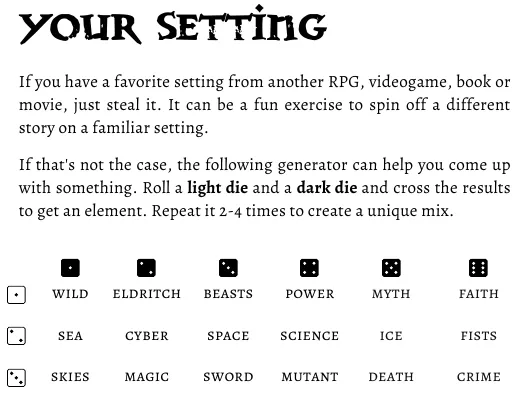
The game provides a unique setting generator that allows you to create a custom world for your gameplay in just a couple of dice rolls.
With a tailored, light-weight system, gameplay is focused on building up narrative and leverage so that, in the final scene, you can confront the accusations, and maybe redeem yourself from your alleged mistakes.
Overview
The Outcast requires little prep. We’re basically playing a one-shot in a setting and with a concept of our choice, maybe inspired by other media, or quickly created using the game’s generators.
We only need 2d6 to play, preferably one of each color. They are referred to as light and dark dice.
Most of the tables in the game use a d66 roll.
Character creation is done alongside setting and the first mission, so everything is woven together.
The first mission is actually decided before character to have an idea of who is suited for the story we’re telling/playing.
The core gameplay loop centers around framing narrative scenes by answering five simple questions: Where, Who, Want, Obstacle, How.
Want and obstacle, or goal and conflict, are classic fiction building blocks. Great, simple stuff to kickstart a story.
There are other tables and oracles to help with further setting the scene, like Yes/No, Spark, and Intensity.
Edges and Snags
Characters are equally easy to create. Our exile begins with 3 Edges and 2 Snags.
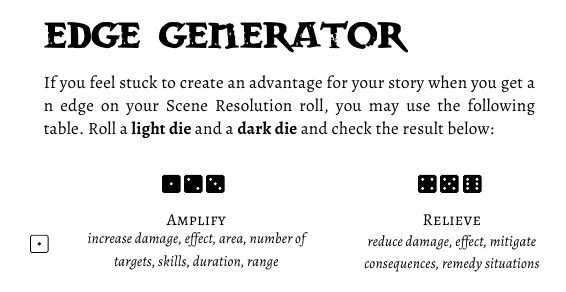
Edges are general advantages we can call upon during rolls and scenes, like skills, gear, allies, powers, etc. We can’t accumulate more than 10. Mechanically, they are used to reroll dice.
Snags are disadvantages that can complicate our lives, like injuries, enemies, debts, traumas, etc. We can’t have fewer than our 2 starting ones. If we accumulate more than 5, we must Face Desolation, a check that can mean game over.
There are also tables to generate Edges and Snags!
Scenes
After the initial setup is done, we are ready to start. Scenes are played in two roll phases, Warm-Up Rolls and Scene Resolution.
Warm-Up Rolls are narrative and have no mechanical consequence. We use them to check how smaller details unfold, like picking a lock, climbing a wall, starting an interaction with someone, etc. They serve to establish positioning and overall details and tension for the scene.
Scene Resolution is the main roll of the scene at its climax. This dictates how successful we are at the scene and whether our progress toward our mission increases or we suffer a setback.
Results and rerolls
Success or failure during scenes depends on the rolls of the light and dark dice.
For the Warm-Up Rolls, the table is simple:
- Light > Dark: Things go in our favor.
- Light = Dark: A surprising element is added to the scene.
- Light < Dark: Things go against us.
Again, they are just to flavor the scene.
For the Scene Resolution roll, we have a matrix to check.
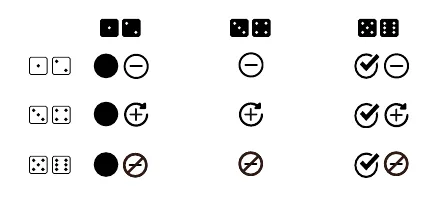 The black dot is a taint on the Progress Track. The minus symbol adds (or remove) a Snag. The plus symbol adds or refreshes an Edge, and the checkmark is a success on the Progress Track.
We can swap the light and dark rolls to get a different result on the matrix. That’s a strategic choice. For instance, at a certain point, it might be more important to remove a Snag than to gain or refresh an Edge and mark a Progress point.
We can also spend an Edge to reroll the dice. That Edge can’t be used again until refreshed.
Progress
The Progress Track contains 5 marks that can be a success or a taint. These come in play during the Final Scene, where each success adds a +1 to the light die, and each taint a +1 to the dark die.
The final check can’t be rerolled or swapped! It decides whether our quest for redemption is successful, unclear, or a failure.
Setup
That’s enough of an overview, let’s start this playthrough!
We’ll establish setting, character, and backstory.
Setting
Setting Table rolls: Beasts, Ruins, Skies, Occult
I’m going with a world of sky islands, populated by several clans of monster hunters, each with specific duties.
Let’s roll on the Absolutely Awesome Fantasy Names for my character: Savoro Kingswood
Savoro belongs to the Abyss Watchers, those closest to the void below the islands. They’re tasked with studying the black clouds that cover the ruined surface of the world.
They observe the movements in the darkness to predict patterns and anticipate attacks from sky leviathans and storm beasts that rise from below to wreak havoc above.
To navigate the islands and hunt the beasts, the clans use skiffs with canvas sails that capture the violent updrafts from the void below, and tanks filled with gas harvested from the lungs of some sky beasts.
The Abyss Watchers looked too long into the void and reached the ancient gods of the deep. They made pacts with them for power in exchange for blood. They sacrificed fellow hunters because of the visions they received.
Backstory and First Mission
I’ll roll on the Sparks table for backstory ideas: Decline, Water, Illusion
Savoro glimpsed into the void and saw a tentacled ancient god sleeping beneath the bottomless ocean.
The entity opened one eye and stared into his soul, marking Savoro. He saw flashes of the future (Edge idea!) and the illusion behind the covenant with those horrors.
First Mission table rolls: Create, Place
I’ll roll on a table to check how my character approaches problems: Finesse
Alright, so after the vision, Savoro kept to himself. He planned to warn the High Council of hunters about the impending doom, moving swiftly, without calling attention to himself, but his actions were anticipated. Maybe the Abyss Warden elders can also glimpse into the future?
He was ambushed, but managed to survive the assassination attempt, killing a few hunters with his skills as an archer (another Edge), setting traps and outsmarting the attackers.
The elders killed the remaining survivors and accused Savoro of murder and betrayal, making him a wanted man.
Savoro boarded a skiff from his ambushers and fled. His goal now is to clear his name by organizing a resistance group (maybe formed by the many discontents and deserters created by the clan’s pact with the ancient ones) and exposing the Abyss Watchers.
Character creation
Let’s finish fleshing out Savoro Kingswood.
Concept: Disgraced and hunted Abyss Watcher who glanced behind the veil of his clan’s dark covenant.
Now for Edges and Snags. I didn’t roll for those as they became pretty clear to me with the backstory.
Edges (+)
- Flashes of the Future. The contact with the ancient one sometimes allows Savoro to glimpse the future.
- Watchers’ Gear. Equipment for hunting beasts like bow and arrows, traps, rope, and other tools.
- Finesse. I left it as Finesse to represent stealth, speed, precision, smarts, etc.
Snags (-)
- Marked by the Ancient One. The entity’s gaze lingers in Savoro’s mind. Sometimes, visions of terror paralyze him, or its cold voice whispers dark secrets.
- Hunted by the Abyss Watchers. Savoro’s clan branded him a traitor and is actively hunting him.
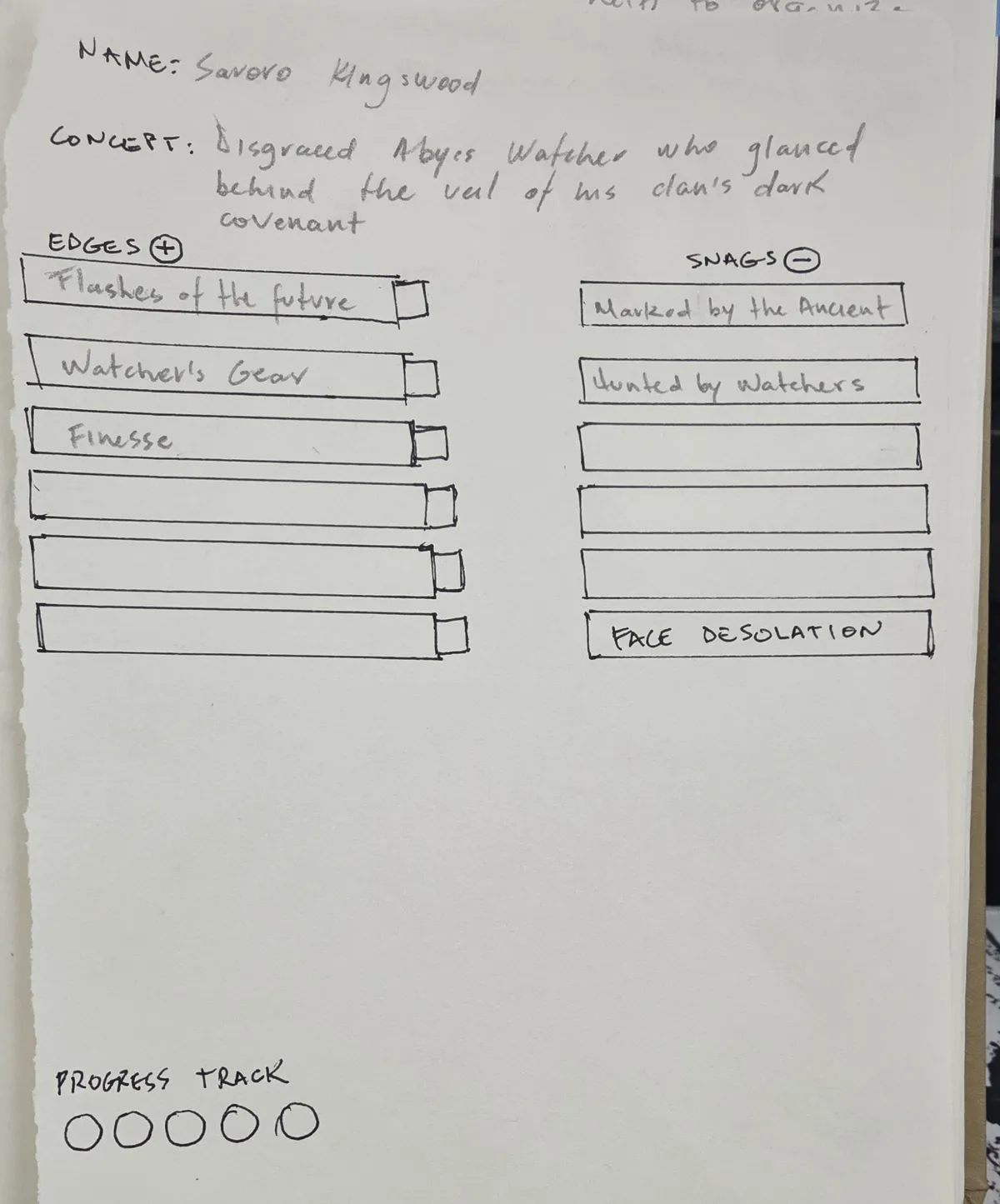
And that’s it for the setup! Pretty cool for a start, right?
It’s really easy to create something narratively satisfying using the game’s tools. There’s a lot to help with ideas.
We started with Beasts, Ruins, Skies, and Occult, and somehow ended up with skyships, hunting clans, ancient gods, blood sacrifices, and a disgraced archer looking to start a rebellion.
Not too shabby.
We’ll build on Savoro’s first mission next session and start playing.
See you then.
The Outcast: A Game of Reputation and Redemption is available on Itch.